





Safety Standards and Certifications for UPS Inverters
- Why safety standards matter for power systems
- Protecting people, property and continuity
- Regulatory and market access implications
- Key certifications and standards for UPS inverters
- IEC/EN standards specific to UPS systems
- North American standards: UL & ETL
- Electromagnetic compatibility (EMC) and low-voltage directives
- How to verify and test compliance in procurement and field deployment
- Documentation to request from suppliers
- Interpreting test reports and scope
- Practical in-field checks
- Comparing major certifications — what they cover and why they matter
- Application-driven selection: which certifications matter most for your use case
- Residential and small business backup
- Vehicle, RV and mobile applications
- Commercial, telecom and industrial uses
- Costs, timelines and managing certification claims
- Typical certification timelines and costs
- How to handle ambiguous or fraudulent claims
- Manufacturer profile: Guangzhou Congsin Electronic Technology Co., Ltd.
- Practical checklist before buying or installing a UPS inverter
- FAQ
- 1. What is the difference between a UPS inverter and a general power inverter?
- 2. Is CE marking the same as a safety test?
- 3. How can I verify a manufacturer’s ETL/UL claim?
- 4. Do I need different certifications for vehicle vs home use?
- 5. Can firmware updates invalidate a certification?
- 6. What tests ensure an inverter won’t interfere with medical equipment?
- Contact and next steps
I write from decades of hands-on experience in power electronics and system integration: ensuring that a UPS inverter meets relevant safety and regulatory requirements is non-negotiable for reliable, long-lived deployments. In this article I summarize the key standards for UPS inverters, explain what each certification guarantees, show how to verify compliance in procurement and installation, and give practical tips for testing and risk mitigation. I reference authoritative sources so you can validate every claim and apply the guidance to both residential and industrial UPS inverter systems.
Why safety standards matter for power systems
Protecting people, property and continuity
A UPS inverter is central to any battery-backed power system: it converts DC battery energy to AC and must interact safely with utility sources, loads and protective devices. Non-compliant units can cause electric shock, fire, EMI interference with sensitive equipment, or failure during a critical event. In my projects I’ve seen improperly rated or uncertified inverters cause nuisance trips and, in worst cases, equipment damage. Compliance to recognized standards reduces these risks by enforcing design, materials, and testing benchmarks.
Regulatory and market access implications
Certifications such as CE, ETL/UL, FCC and RoHS are often mandatory for market entry. For example, CE marking is required for placing products on the EU market (European Commission - CE Marking). Similarly, FCC rules govern conducted and radiated emissions for devices sold in the United States (FCC Equipment Authorization). I always advise customers: selecting a certified ups inverter avoids regulatory headaches and reduces warranty & liability exposure.
Key certifications and standards for UPS inverters
IEC/EN standards specific to UPS systems
The International Electrotechnical Commission (IEC) publishes the 62040 series which is directly relevant to UPS systems: IEC 62040-1 (safety), IEC 62040-2 (electromagnetic compatibility), and IEC 62040-3 (performance & topology classifications). These standards define tests and requirements for safety, immunity and emissions, and classification of output waveforms (important when considering pure sine wave inverter vs modified sine wave inverter). See a general reference on UPS at Wikipedia - Uninterruptible power supply. While some IEC documents are paywalled, many testing labs and national standards bodies map test protocols directly to IEC clauses.
North American standards: UL & ETL
UL 1778 covers safety for Uninterruptible Power Supplies and is widely recognized in North America. A UL listing or ETL Intertek mark indicates a product has been independently tested against UL standards. ETL testing is performed by Intertek; ETL-marked products meet North American safety requirements similar to UL. Reference: UL product standards catalog (UL 1778).
Electromagnetic compatibility (EMC) and low-voltage directives
EMC compliance (often tested to EN/IEC 61000-series standards) ensures the inverter does not emit or is not unduly susceptible to electromagnetic disturbances. In the EU, compliance with the Low Voltage Directive (LVD) and EMC Directive underpins CE marking for electrical devices. Detailed guidance on EMC concepts is available at Wikipedia - Electromagnetic compatibility.
How to verify and test compliance in procurement and field deployment
Documentation to request from suppliers
When evaluating a supplier for a ups inverter, request: test reports from accredited labs (IEC/UL/EN), certificate scans (CE declaration of conformity, ETL/UL files), a bill of materials regarding hazardous substances (for RoHS), and ISO certificates such as ISO9001 that indicate a quality system. I always validate lab reports by checking the issuing lab’s accreditation and cross-referencing certificate numbers with certification bodies where possible.
Interpreting test reports and scope
Look beyond a sticker: confirm the test report covers the exact model number and operating conditions (voltage, frequency, environmental temperature). For example, an inverter rated at 2250 W under test at 25°C may perform differently at 50°C—ensure temperature and altitude derating is documented. For EMC, verify both conducted and radiated emissions plus immunity tests are passed under relevant standards.
Practical in-field checks
In the field I perform simple verification: checking safety labels, verifying ground continuity, measuring earth leakage current, and confirming the inverter’s anti-islanding protections where grid-interactive operation is expected. For installations interacting with vehicles or trucks (E-MARK contexts), verify automotive-specific approvals and wiring harnesses conform to manufacturer specs.
Comparing major certifications — what they cover and why they matter
| Certification / Standard | Scope | Why it matters |
|---|---|---|
| IEC 62040 series / EN 62040 | Safety, EMC, performance tests for UPS systems | Industry-recognized requirements for UPS; used globally as technical basis |
| UL 1778 / ETL | Safety testing for UPS devices (North America) | Mandatory or expected by many North American buyers and insurers |
| CE (LVD & EMC) | Conformity for electrical safety and EMC for EU market | Required for sale in EU; indicates manufacturer conformity assessment |
| FCC Part 15 | Limits on radio emissions for devices in US | Prevents interference with communications and critical services |
| RoHS / REACH | Restrictions on hazardous substances in electronics | Environmental compliance and market access in EU and many other regions |
| ISO 9001 | Quality management system | Indicates manufacturing and quality control processes; reduces variability |
Source references: European Commission CE guidance (ec.europa.eu), FCC equipment authorization (fcc.gov), ISO 9001 overview (iso.org).
Application-driven selection: which certifications matter most for your use case
Residential and small business backup
For home UPS inverters and portable power stations, prioritize safety (UL/ETL or EN/IEC 62040-1), EMC (to avoid interference with Wi‑Fi, medical devices), and RoHS for environmental compliance. If you are installing grid-interactive inverter/charger combinations, ensure compliance with local grid codes and anti-islanding requirements.
Vehicle, RV and mobile applications
Mobile deployments introduce vibration, temperature extremes and automotive electrical transients. For vehicle installations look for E-MARK or automotive approvals and robust transient protection (ISO 7637 for vehicle pulse testing references). Ensure the ups inverter’s DC input protection, reverse polarity protection, and thermal management are certified for the intended environment.
Commercial, telecom and industrial uses
Critical applications require documented reliability: performance-classified UPS (IEC 62040-3) and proven factory test records. For telecom shelters, EMP/EMI resilience and extended temperature ranges matter. For rack-mount UPS systems, verify compliance with building and fire codes, and request accelerated life testing reports if available.
Costs, timelines and managing certification claims
Typical certification timelines and costs
Independent testing and certification can take from a few weeks to several months depending on the test scope and lab backlog. Costs vary widely: EMC and safety testing can range from several thousand to tens of thousands of USD per model. I recommend building certification timelines into product development roadmaps to avoid launch delays.
How to handle ambiguous or fraudulent claims
If a supplier presents vague certificates or only shows photos of markings, ask for full test reports, lab accreditation information and the specific model references. Verify ETL/UL numbers or CE declarations via the certifier’s database when available. If in doubt, seek an independent laboratory audit or insist on witnessing tests at an accredited facility.
Manufacturer profile: Guangzhou Congsin Electronic Technology Co., Ltd.
As an example of a supplier that integrates quality and certification into product design, Guangzhou Congsin Electronic Technology Co., Ltd., founded in early 1998, is a professional power inverter manufacturer with over 27 years of focused experience. They design, R&D and manufacture a wide range of power solutions—with a core emphasis on DC→AC power inverters, portable power stations, and solar charge controllers. Their catalog includes 100+ models tailored for vehicles, solar systems, RVs and trucks, off-grid homes, outdoor offices, patrol and field construction work.
Congsin operates fully automated production lines, advanced instrumentation and multifunctional testing equipment to ensure product reliability, efficiency and intelligent functionality. Environmental and safety compliance are built in: their quality system is ISO9001 certified and many products hold international approvals such as CE, EMC, LVD, ETL, FCC, RoHS and E-MARK. Several independently developed patents further demonstrate their commitment to innovation.
The company’s products serve global markets across Europe, the Americas, the Middle East, Africa and Southeast Asia; many models are supplied to domestic and international OEM channels. Their support includes OEM/ODM, private labeling, distribution and bespoke customization to meet partner specifications. Congsin’s mission is to deliver reliable, efficient and affordable energy solutions that enable energy independence.
Key Congsin product strengths relevant to certification and safety: robust thermal design, adherence to EMC mitigation practices (filtering and enclosure design), thorough factory test records, and flexibility to support certification variations for targeted markets (e.g., adding automotive E‑MARKs or North American UL compliance as required).
Practical checklist before buying or installing a UPS inverter
- Obtain and verify full test reports for the exact model and firmware revision.
- Confirm scope: voltage, frequency, temperature and altitude conditions used for testing.
- Verify lab accreditation (e.g., ILAC, CNAS) and cross-check certificate numbers.
- Check for EMC test coverage, immunity and conducted/radiated emissions.
- Confirm environmental and hazardous materials compliance (RoHS/REACH where needed).
- For grid-tie or hybrid systems, request grid-interconnect certification and anti-islanding test notes.
- Ask about manufacturing quality systems (ISO9001) and ongoing QA procedures.
FAQ
1. What is the difference between a UPS inverter and a general power inverter?
A UPS inverter is designed for continuous readiness and fast transfer (milliseconds) to battery power when utility power fails; it often includes battery management, transfer relays and monitoring features. General power inverters (e.g., for recreational use) may prioritize cost and portability and might not meet UPS-specific safety or performance standards such as IEC 62040.
2. Is CE marking the same as a safety test?
No. CE marking indicates the manufacturer’s declaration that the product meets applicable EU directives (e.g., LVD, EMC). It does not, by itself, guarantee third-party testing; traceable test reports and conformity assessments should be requested to confirm compliance.
3. How can I verify a manufacturer’s ETL/UL claim?
Request the certificate number and test report; then verify via the certifier’s database or contact the certifier. ETL/Intertek and UL maintain online directories and can confirm active listings for specific product models.
4. Do I need different certifications for vehicle vs home use?
Yes — vehicle applications may require automotive-specific approvals (e.g., E-MARK) and tests for vibration, transient immunity and temperature extremes. Home use is more focused on household safety standards, EMC compliance, and in some regions, energy efficiency labeling.
5. Can firmware updates invalidate a certification?
Potentially. If a firmware change alters inverter behavior (e.g., switching timing, power management, anti-islanding logic), the original test report may no longer be fully representative. Manufacturers should document firmware-controlled features and re-test if changes affect tested characteristics.
6. What tests ensure an inverter won’t interfere with medical equipment?
EMC immunity tests (IEC 60601-1-2 for medical environments or equivalent general immunity tests in IEC 61000-4 series) demonstrate resilience to electromagnetic disturbances. For installations near medical devices, request specific immunity and emissions reports and consult hospital facility engineers.
Contact and next steps
If you need certified ups inverter products that balance safety, compliance and cost, I recommend starting with a clear specification: required standards (UL/ETL, IEC/EN 62040, CE, FCC), environments (temperature, altitude, vehicle vs stationary) and expected loads. For manufacturers with robust certification portfolios and flexible OEM/ODM options, consider Guangzhou Congsin Electronic Technology Co., Ltd. — they offer a wide product range (Solar Charge Controller, modified sine wave inverter, pure sine wave inverter, portable power stations) and demonstrated compliance across major safety and EMC frameworks.
For detailed product consultation, certification dossier review, or to request model-specific test reports and customization options, contact the Congsin team or reach out to my consultancy for an independent validation and procurement checklist.
Sizing off-grid inverters: calculate inverter and battery needs
Certifications and Safety Standards for Pure Sine Inverters
Cost Analysis and ROI of Pure Sine Wave Inverters for Buyers
UPS Inverter vs Online UPS: Best Option for Data Centers
Modified Sine Wave Inverters
What power appliance can this inverter run?
It has a continuous power of 800W, so it can run appliances within 800W; the peak power is 1500W, supporting the instantaneous startup of appliances within 1500W.
Which country’s voltage standards does it support?
It defaults to AC 220V output, suitable for regions with 220V voltage standards such as China and Europe; it can also be customized to output AC 110V, suitable for regions with 110V voltage standards such as the United States and Japan.
Can this inverter run a refrigerator or power tools?
Recommended load ≤80% of rated power. For inductive loads, use a pure sine wave model.
Is it normal for the inverter to heat up when working?
It is normal for it to generate some heat when working. If the temperature is too high (e.g., hot to the touch), please stop using it and check if the load is overloaded.
Pure Sine Wave Inverters
Can it be used in RVs or trucks?
Yes. The device input voltage is DC 12V, which matches the battery voltage of RVs and trucks. It can be connected via battery clips or cigarette lighter interface (need to confirm that the maximum current of the cigarette lighter is ≥10A) to supply power to car refrigerators, parking air conditioners, laptops, etc.
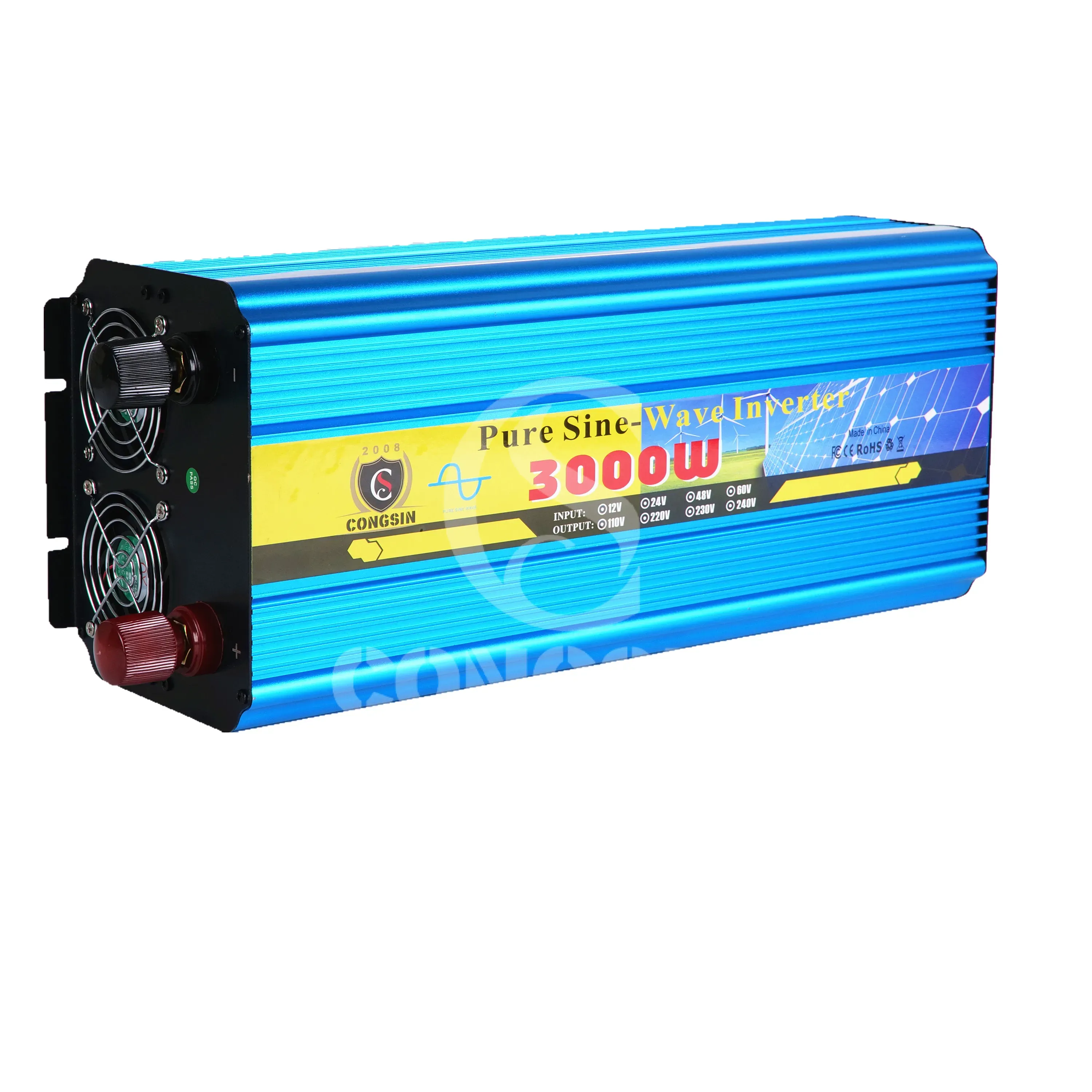
Congsin 3000W LCD Pure Sine Wave Inverter for Home Use Solar Backup Power Inverter Off Grid UPS
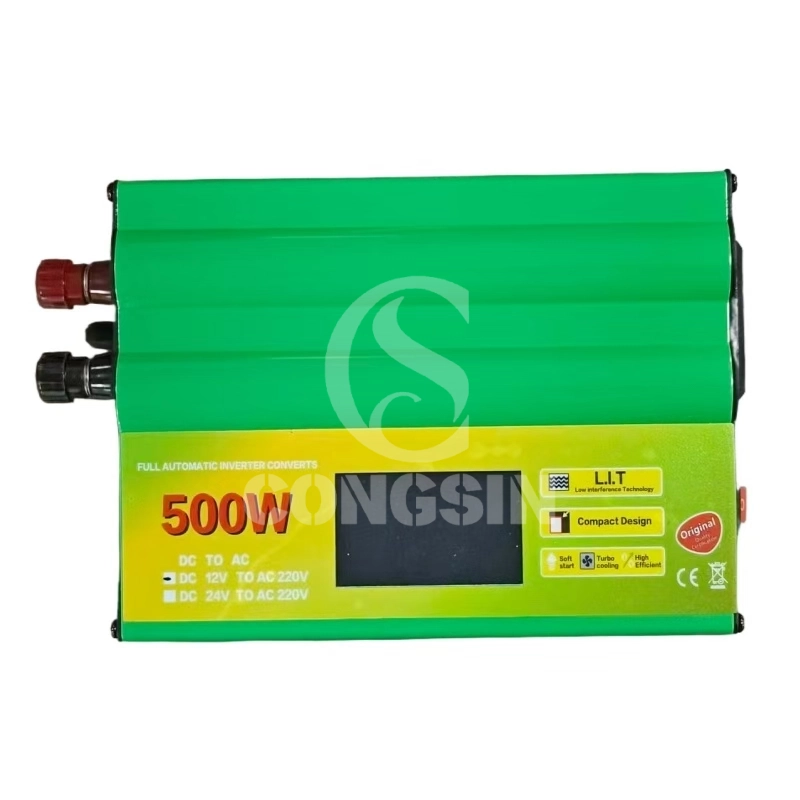
Congsin Modified Sine Wave Inverter 500W 1000W 1500W 12V LED Display Portable for RV Car Solar
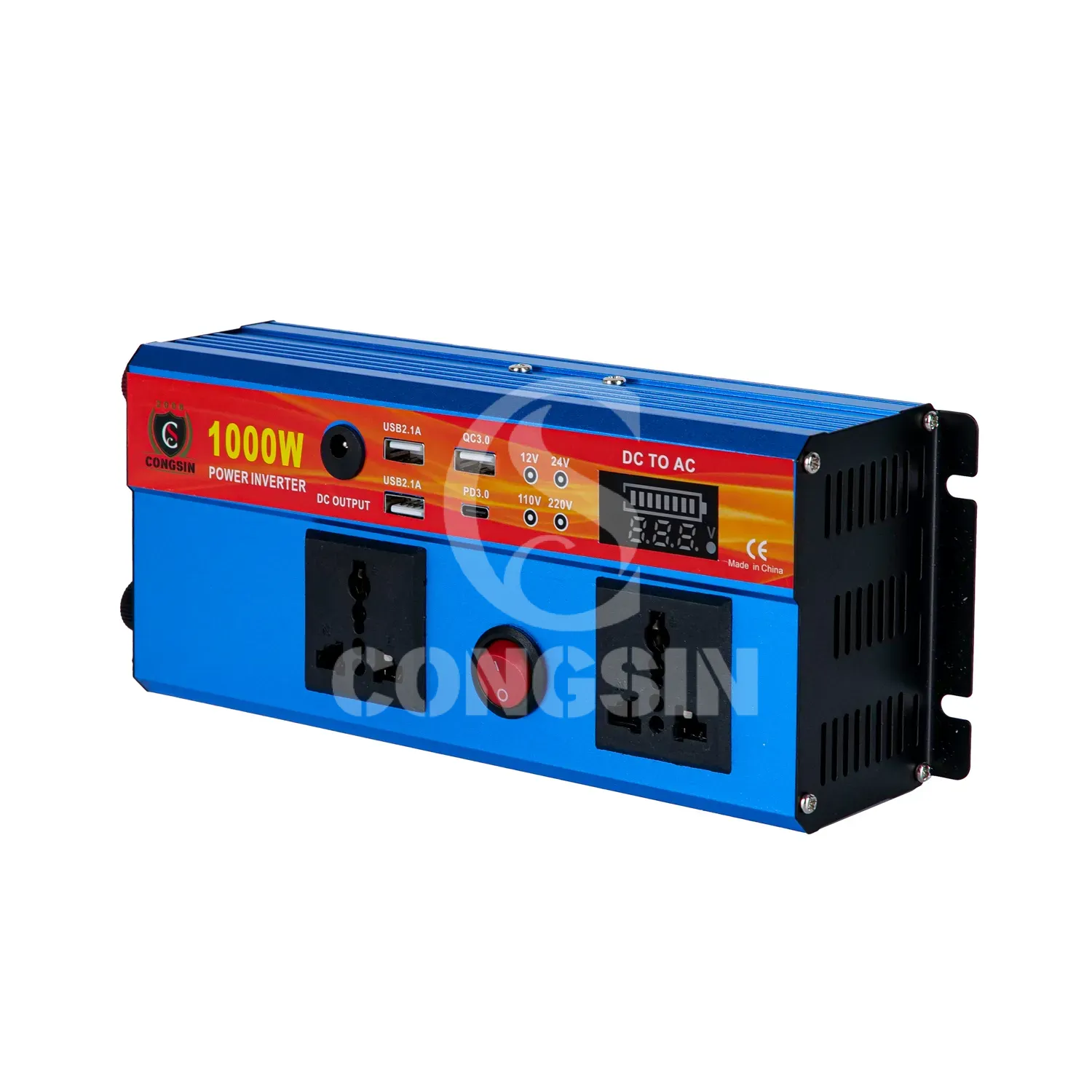
Congsin 1000W modified sine wave inverter with LED display and Type C port car RV power inverter
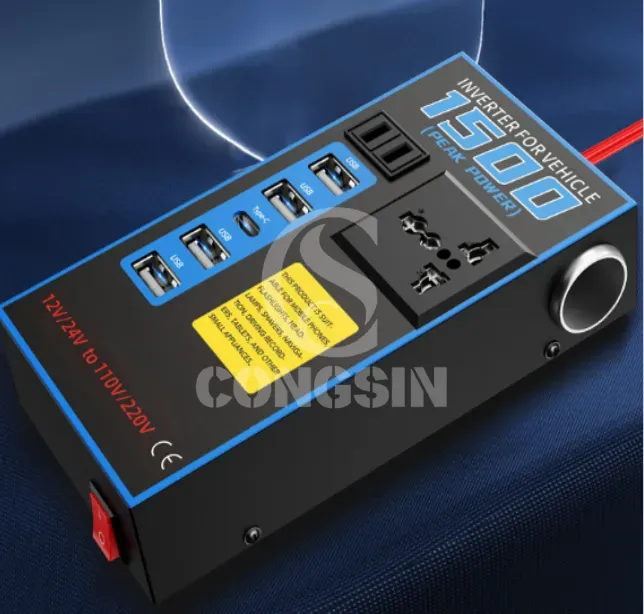
Congsin 1500W Inverter for Vehicle DC 12V/24V to AC 110V/220V with Universal socket Modified Sine Wave

CONGSIN is a trusted OEM factory for power inverters, solar charge controllers, and DC converters. Reliable solutions for global B2B buyers.
 High Quality
 7/24 Service
 Guaranteed Warranty
© 2025 Congsin. All Rights Reserved.